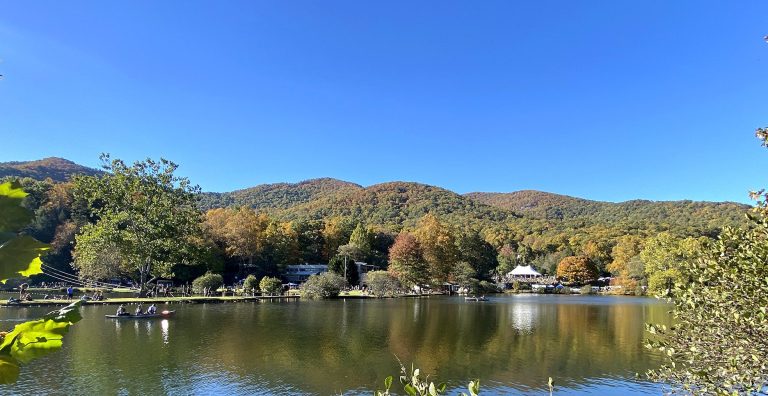
Valley High Farm

The land at Valley High Farm lives up to its name. Situated on a steep mountain slope overlooking the Fines Creek community, this farm-and-forest tract spans 299 acres in the northeast corner of Haywood County. A scenic, winding stretch of NC 209 – also known as “The Rattler” – wraps around one edge of the property. The Great Smoky Mountains National Park, and the 408-acre White Oak Mountain property that SAHC purchased in December 2024, can be seen from the property’s open fields. John Palmer, a dedicated forester with a lifelong love of the land, worked with SAHC to permanently protect Valley High Farm and his beloved Palmer Woods.
“Idyllic pastoral land, an old-growth sugar maple grove, and a storybook historic cabin setting characterize this unique property,” says SAHC Farmland Protection Director Jess Laggis. “The high elevations of this property reach up to 4,400 feet, and it is highly visible from NC Highway 209, which is part of the Appalachian Medley Scenic Byway. The rolling fields of the farm have served to host cattle herds for ‘summer vacation’ over the years – but the rich biodiversity of the tract’s forest makes it particularly important for conservation.”


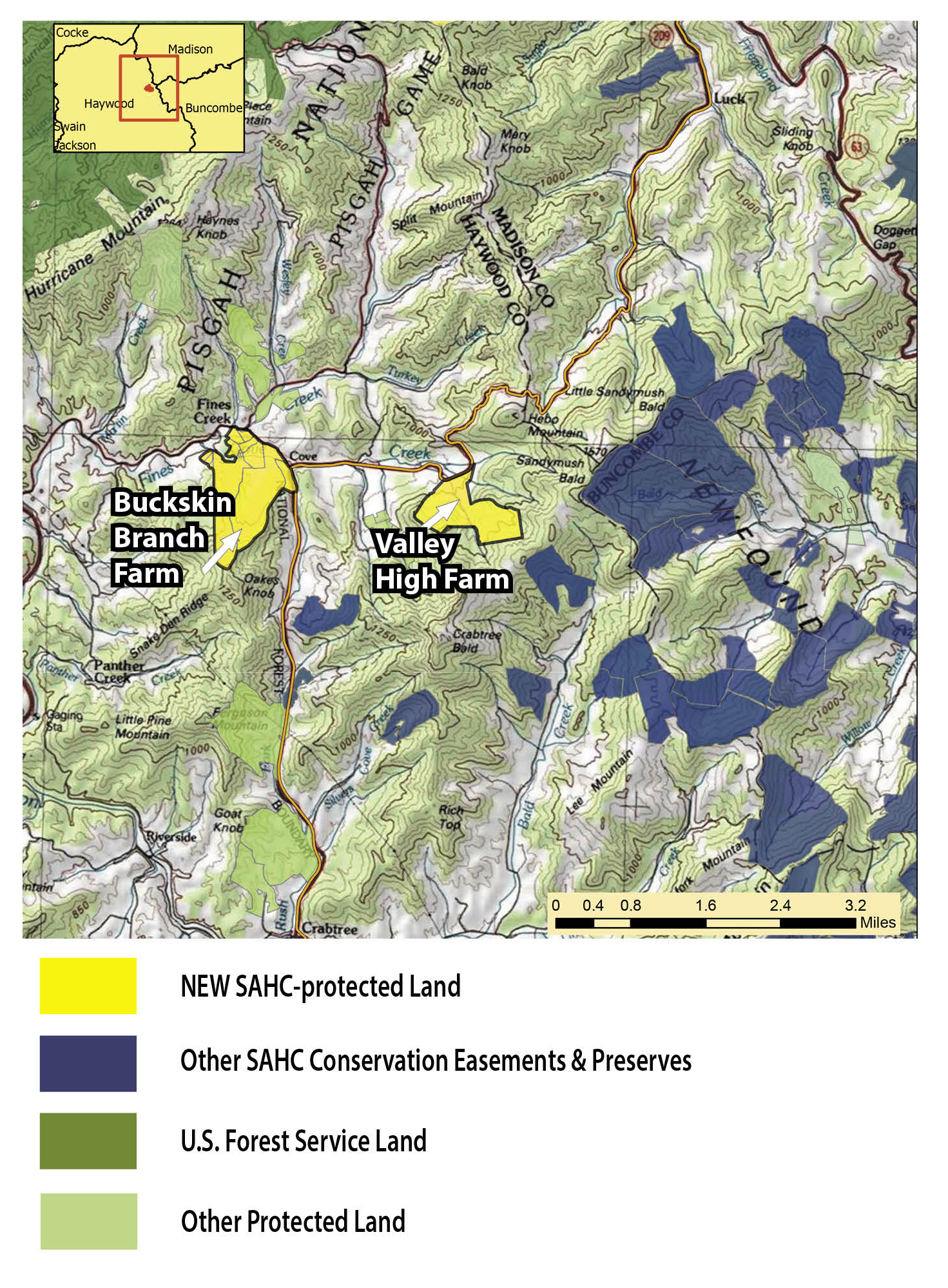
Protecting the land also helps protect water sources. Tributaries of Cove Creek (Buckeye Cove Branch, Sugar Cove Creek, and Turkey Cove Branch) flow through the property and eventually into Fines Creek and the Pigeon River. Permanent protection of such a large tract of forest and open space farmland will help ensure that these water resources are forever protected from the impacts of sedimentation caused by development. An active farm with historic tobacco barn and hog pen structures still standing, Valley High Farm has been used for growing a variety of crops including tobacco, potatoes, trellis tomatoes, and corn – and especially for cattle grazing. Exclusion fencing and watering systems help to protect water quality on the property.
“At one point, cattle from Buckskin Branch Farm down in the Fines Creek valley were herded up the road to the summer grazing land here at Valley High Farm,” recalls John. “More recently, livestock has been loaded onto trucks and driven up instead, as there are a lot more vehicles on the road now.”


The large forested area and boulderfields of the property create healthy habitat for a wide diversity of species, and the undeveloped ridgelines serve as corridors for wildlife movement. John’s love and respect for the land have been reflected in his decades of careful stewardship of the property. A retired forestry professor and campus arboretum director who taught for 30 years at Haywood Community College, John often brought students out to his forested land to experience it as an outdoor classroom.
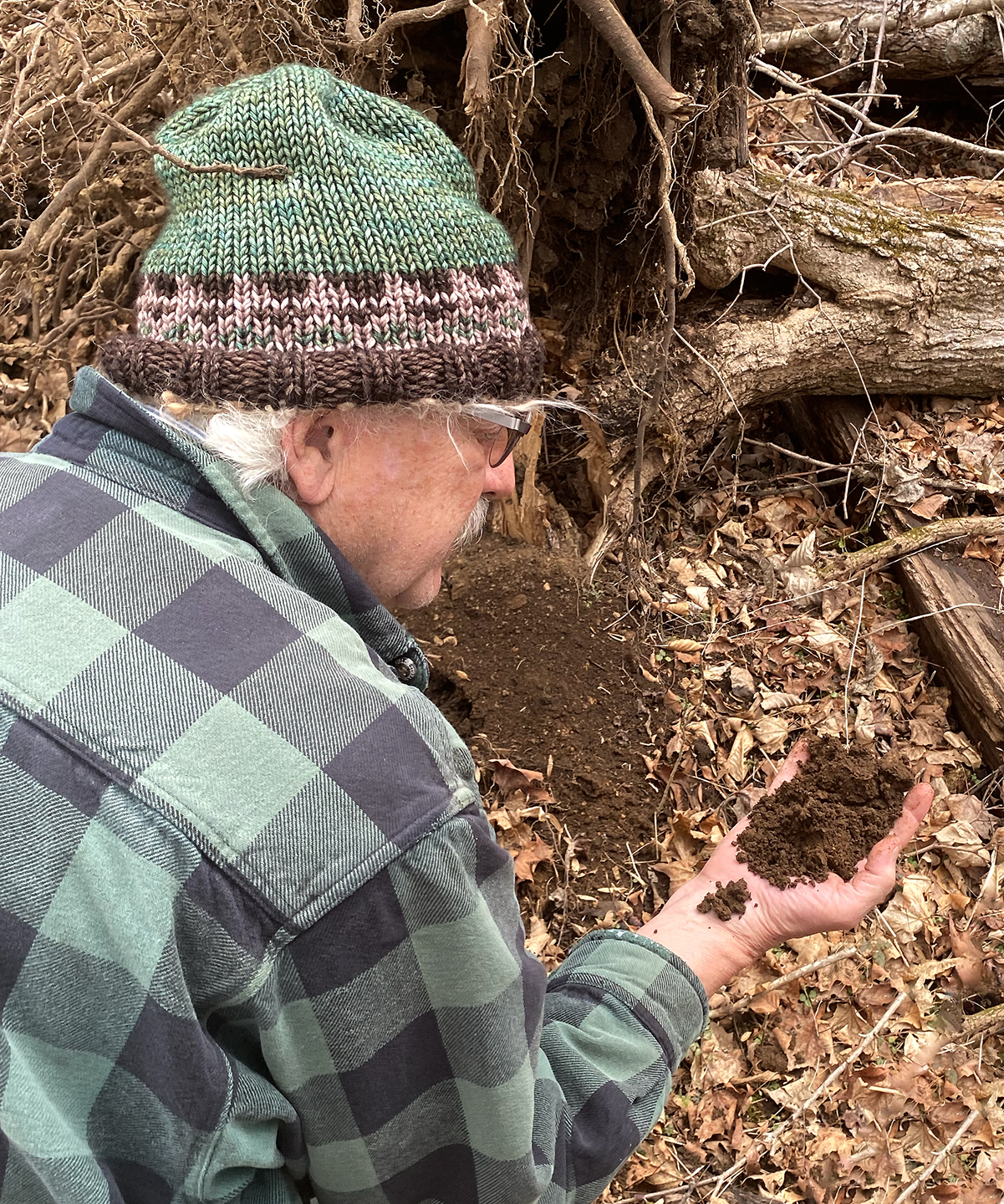
Walking through the tract with SAHC staff, he points out different species of trees and then scoops up a handful of rich, dark earth to emphasize the quality and fertility of the soil.
“This space will become socked in with stinging nettle in the warmer months,” he says, gesturing to a low-lying area which absorbs water running down from the nearby Crabtree Bald. John describes interesting aspects of the forest in all four seasons, adding, “In Spring the land will be covered with beautiful wildflowers.”
In addition to a significant stand of mature, 200+year-old sugar maple trees, a mix of hickory, cherry, yellow poplar, and sugar maple saplings grow interspersed. John describes the change in forest type from one area to another, pointing out the higher elevation oak forest and northern hardwoods forest type, with walnuts, black cherries, bitternut hickory, buckeyes and sugar maple. A natural, rocky indentation on one side of a forested cove creates a natural amphitheater. Over the years, John has used the area as a lecture and lesson space for students, and as a gathering place for forestry groups.


Conservation of the land was made possible by generous SAHC supporters and a grant from the Pigeon River Fund of The Community Foundation of Western North Carolina.

Palmer Family Legacy
“My father, Joe Palmer, purchased this property around 1950,” recalls John. “It was owned by the McCracken family before that and sold at auction. My father came over to the auction with his father, who did the bidding and put up about half of the purchase money for the land.”
Joseph (Joe) Palmer hailed from Ferguson and Palmer families with generations-long histories in the mountains of Haywood County, traceable to some of the earliest colonial settlers of the region. He was raised on the family farm in the Rush Fork community.
“He was such a special individual,” recalls John. “He just had that kind of personality that brought people together, and he had the ability to get to know, understand, and work with everyone. He served in WWII as a Marine in the Pacific, and he came back with a bronze star, as a hero. His father convinced him to go into politics. He ran for state office and won; he was the youngest legislator in Raleigh at that time. He was a born politician. Everybody liked him.”
Joe Palmer continued to purchase and consolidate land in the Fines Creek area. In the 1960s, he began purchasing land that became part of Buckskin Branch Farm, owned by Johns’s brother Kim and recently protected by a conservation easement held by SAHC. Joe became a well-respected public figure who represented the people of Western North Carolina in the state legislature for many years, and members of the local community still remember him fondly.
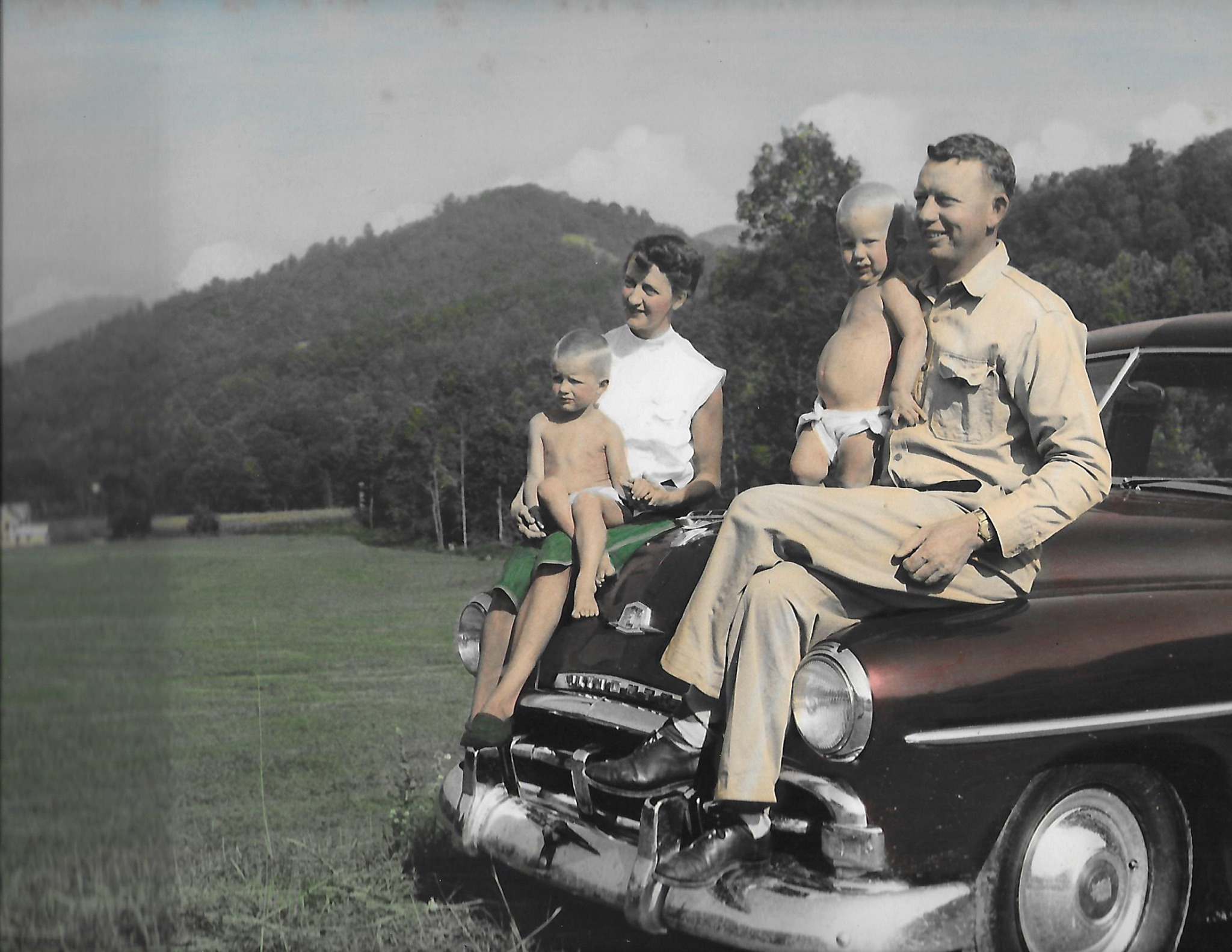

“Mother was a very intelligent lady and extraordinary in her own right,” adds John. “She has three degrees – from UNC Asheville, UNC Greensboro, and Western Carolina University. She taught at many different schools and later became a guidance counselor at Pisgah High School in Canton. Her former students loved her, and she helped open doors for many young women.”
As a boy, John recalls that the farmers of the Fines Creek community gathered at the farm in the summer for an annual sheep roast event. The nearly 100-year-old cabin on the property contains a large rock hearth and chimney. Still functioning to heat the modest homespace on a chilly, wintry day, the hearth once served to cook meals for the community sheep roast.
Distinguished Career in Forestry
Preserving the forest and Valley High Farm serves as John’s legacy for future generations, as well as a tribute to his parents. A distinguished forestry professor, he recalls that his mother inspired him to create a career from his love for trees and outdoor spaces.
“As with many of my students, I was inspired to go into this field at a young age,” shares John. “My mother bought a book on national parks of America, and I was paralyzed by it – loving and wanting to know about everything in every picture. I told her ‘this is what I want to do,’ and she was very supportive. I wanted to study plants.”
John pursued two bachelor degrees at NC State University – one in forestry and one in conservation – and then worked overseas in the United Kingdom Forestry Commission for a while. Returning to the U.S., he assumed a graduate teaching assistantship in the forestry program at the University of Tennessee (UT). After working as an instructor at UT and a seasonal naturalist at Great Smoky Mountains National Park, he found an opening at Haywood Community College (HCC) in his home county – and felt he’d come full circle.
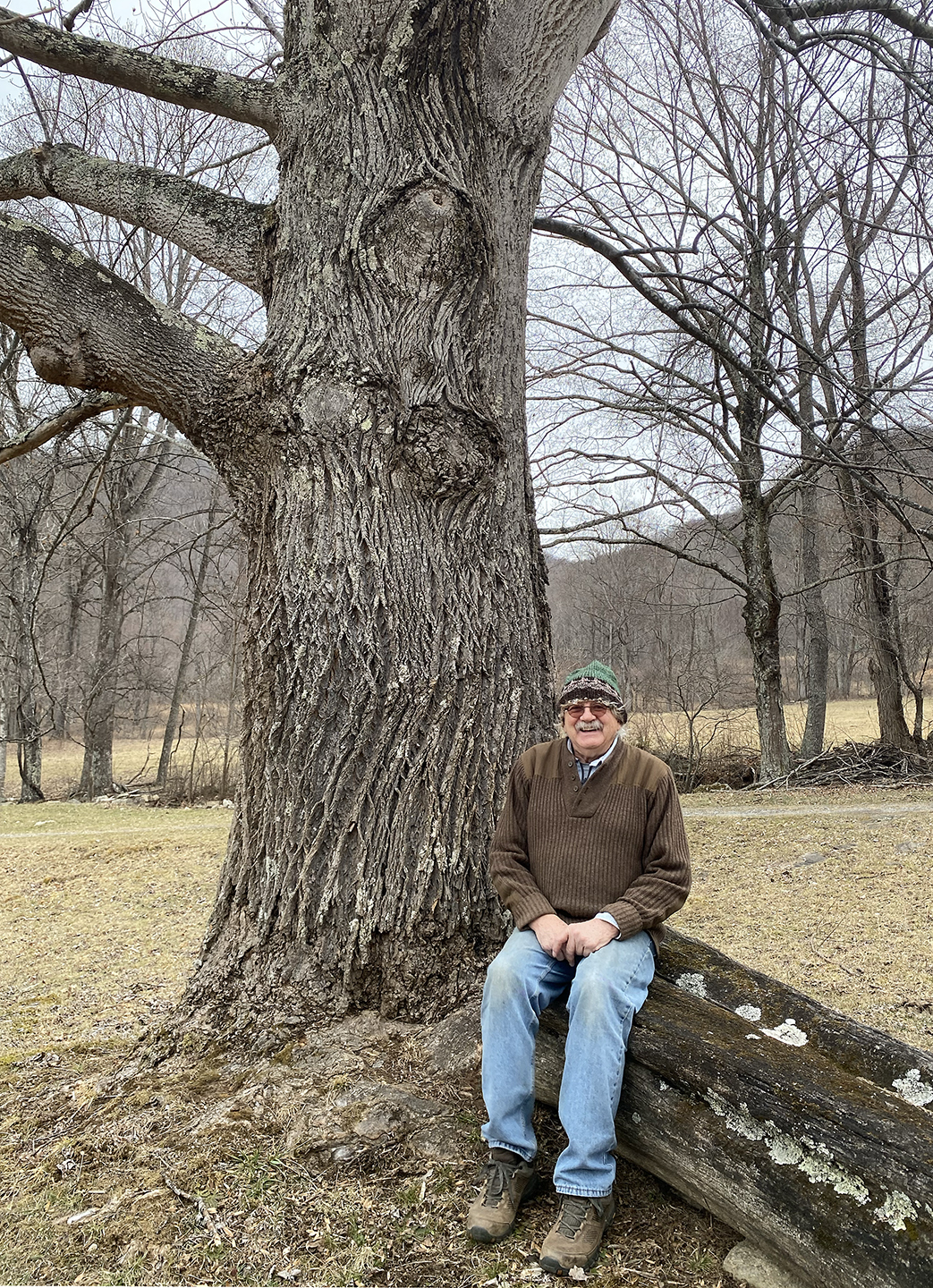

Along with his teaching John was the founding director for 30 years of the HCC Campus Arboretum, creating the Rhododendron Woodland Garden, the gristmill, and the oak entrance boulevard. He taught Dendrology, Botany, Forest Recreation, Forest Entomology, Nature Hiking, and for 25 years conducted a tent camping expedition through the Florida Everglades & Keys. John was also the faculty advisor for the student lumberjack team and founded the annual Intercollegiate Woodsmen’s Competition at the Cradle of Forestry that now honors his name. Professor Palmer became a Fellow of the Society of American Foresters (SAF) in 2002, their NC Chair in 2007, and led an SAF forestry tour through Germany in 2014. In addition he has led large delegations of dendrologists from around the world on 13 major tours to see virtually all the native forests in America. In January 2025, John became the President of the International Dendrology Society, headquartered in England, for a 4-year term.


Post-Helene Forest Impacts
When Hurricane Helene passed through the region on September 26-27, 2024, much of the property’s 299 acres survived the storm without damage. However, the prized sugar maple forest suffered severely. John counted 30 or more of the largest trees on the ground, most around 200 years old. Along with the maples, a huge black cherry and a massive black walnut tree were brought down. However, many younger trees were spared.
“I never thought I’d see these trees fallen over and ripped up,” shares John, distraught by devastation of the much-loved trees. “As a forester, I understand that there is a cycle of the forest, but I just didn’t think I’d see this end stage of tree life during my generation. These are big, high quality trees that have come down because of the devastating force of the storm. Harvesting them in an environmentally sustainable way and using the resources in a thoughtful manner is a way to celebrate and honor their lives.”


The sugar maple forest on the property is one of the largest and best examples of its kind in the southeastern United States. Removal of the fallen and damaged trees will help the remaining younger trees grow to maturity.
“Palmer Woods was impacted by the heavy rain and strong winds from Hurricane Helene,” shares SAHC Stewardship & GIS Manager Chris Kaase. “Most notably, a stand of mature sugar maples (Acer saccharum) at the heart of the forest suffered a windthrow event resulting in the fragmentation of the canopy, with many mature specimens being uprooted and blown down. Under the stewardship of John Palmer, this forest has been visited by countless students, forestry professionals, and conservationists for decades. The tenets of sustainable land use are at the core of proper forest management. A salvage harvest planned for this particular forest stand will serve two purposes: it will improve accessibility to the forest itself, allowing future visitors in SAHC’s outings program to safely traverse the area, and it will utilize unique timber resources that would otherwise go to waste. While the Palmer Woods perfectly exemplifies the rich cove forest type, it is the occurrence of the near-pure sugar maple stand that sets it apart.”
A planned timber salvage harvest project will be limited to an approximately 7-acre area that contains the ecologically significant and scenic grove of sugar maple trees. John will work with forestry professionals to plan the project through a Forest Management Plan and coordinate with SAHC stewardship staff to ensure that conservation values of the property are protected.