 https://appalachian.org/wp-content/uploads/2020/09/WilesCreek3-e1600973309797.jpg
590
1439
sahcadmin
https://appalachian.org/wp-content/uploads/2022/06/cropped-LogoUpdate_SingleHiker-300x300.png
sahcadmin2020-09-24 20:16:042020-09-28 19:44:45Wiles Creek
https://appalachian.org/wp-content/uploads/2020/09/WilesCreek3-e1600973309797.jpg
590
1439
sahcadmin
https://appalachian.org/wp-content/uploads/2022/06/cropped-LogoUpdate_SingleHiker-300x300.png
sahcadmin2020-09-24 20:16:042020-09-28 19:44:45Wiles Creek
Conservation Story
“In many ways, these are some of the best-of-the-best conservation projects,” says SAHC Executive Director Carl Silverstein. The municipal watershed conservation projects that Southern Appalachian Highlands Conservancy has completed in the Western North Carolina mountains help protect water quality in drinking water reservoirs, as well as preserving important wildlife habitat and scenic views from the beloved Blue Ridge Parkway.
Since the early 2000s, SAHC has been working with local municipalities to permanently protect over 11,000 acres of forested land with high-quality streams and pristine water sources. Some of these tracts are no longer used for active drinking water supplies, such as the Rough Creek/Canton and Weaverville watersheds, although they still contain outstanding water resources and high quality habitat, and may provide potential areas for outdoor recreation. Others, including the 8,000+ acre Waynesville Watershed and 1,840-acre Woodfin Watershed, continue to supply drinking water for area residents.
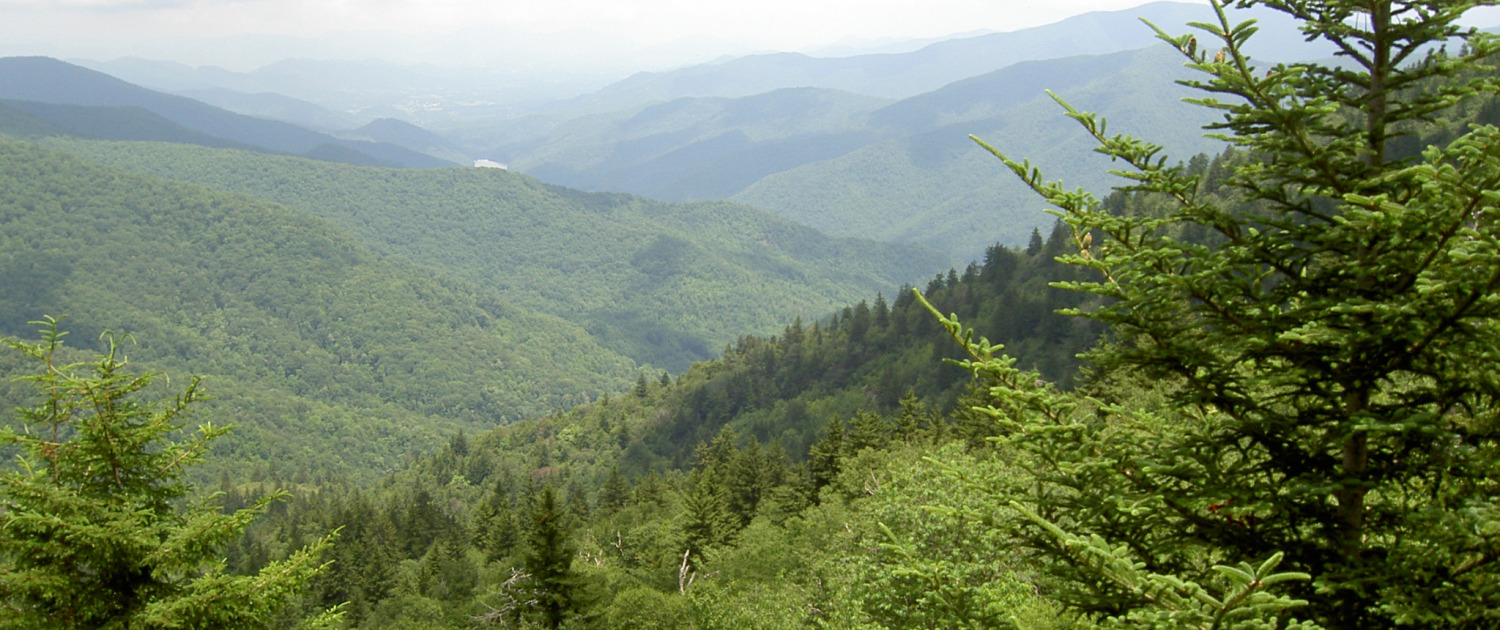
View of Waynesville Watershed from Blue Ridge Parkway. The upper elevations of this protected watershed border the Blue Ridge Parkway in Haywood County.
Project Highlights
Waynesville Watershed
Southern Appalachian Highlands Conservancy, the Conservation Trust for North Carolina, and the State of North Carolina co-hold the conservation easements that permanently protects the 8,040-acre Waynesville watershed. SAHC continues to monitor the conservation easement every year; our stewardship team ensures long-term protection of the land and water resources.
Protection of these resources helps to ensure that high safety standards are met for the drinking water supply of Haywood County and helps preserve a high quality aquatic ecosystem. The jointly-held easement allows active forest management and is often referred to as the ‘working forest conservation easement.’ The watershed contains the upper drainage of Allen Creek and its tributaries. The property’s primary use is as a municipal water supply for the Town of Waynesville and additional parts of Haywood County.
The Waynesville Watershed is contained within the Great Balsam Mountains/Pisgah Ridge Megasite, a nationally Significant Natural Heritage Area, as designated by the NC Natural Heritage Program. Scenic views of the watershed easement properties are visible from the Blue Ridge Parkway along an approximate 10-mile stretch, between mileposts 429.85 and 439.6.
In the early 1900’s, there was a well-established farming community, known as Quinland, within the watershed. There was a history of timber harvesting within the watershed. The Haywood Lumber and Mining Company cut 13,270,000 board feet from 1945 – 1958, and additional logging events occurred in the 1980s. Today, the forested watershed has rebounded, with a healthy diversity of plant and animal life. Researchers and local forestry experts have helped create forest management plans, which guide the rejuvenation and health of the forested land.
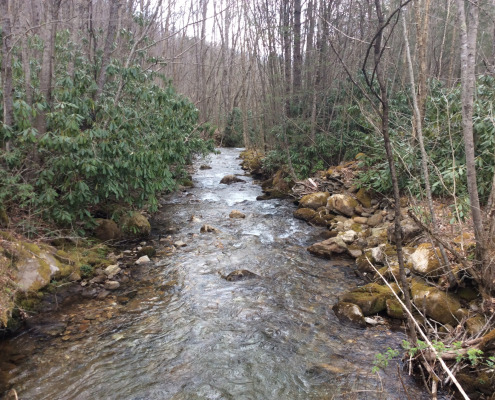

Weaverville Watershed
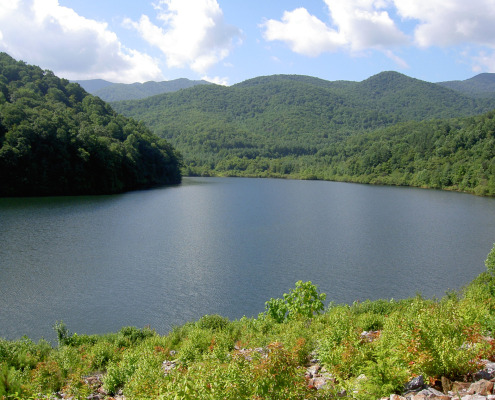
In 2017, Southern Appalachian Highlands Conservancy completed a project with the Town of Weaverville – a conservation easement on 310 acres of the Weaverville Watershed. The easement protects important headwaters of Reems Creek as well as forested habitat and scenic views from Reems Creek Valley.
“This property provided drinking water to the Town of Weaverville for 80 years and is important for conservation because of its water resources,” said Land Protection Director Michelle Pugliese. “It contains the headwaters of Eller Cove Branch and 12 of its tributaries, which run into Reems Creek and eventually the French Broad River. One of the best ways to preserve water quality downstream is by protecting a river’s headwaters – and that is exactly what has happened here. We are grateful to the Town of Weaverville for taking the step to protect this tract and its natural resources for posterity.”
The tract contains a total of 4.2 miles of stream corridor, and its conservation helps protect tributary streams of the French Broad River Watershed from sources of sedimentation and other types of pollution. The Town of Weaverville purchased the watershed property in 1911 and used it as the sole source of drinking water until 1993, when the source was changed to the Ivy River.

Marshall Watershed
Completed in 2018, the conservation easement on the Marshall Watershed provides a haven for a plethora of plants and wildlife. In northwest Madison County, these 541 secluded acres of forest filter miles of clean mountain streams that once provided drinking water to town residents. Southern Appalachian Highlands Conservancy worked with the Town of Marshall to permanently protect the Marshall Watershed property with a conservation easement. Mature forest habitat across the tract creates ample opportunity for native plants and wildlife to flourish, and many trees onsite were estimated to be 100 years old.
This is the SAHC’s sixth conservation easement conserving a municipal watershed lands. Similar easements protect the Weaverville Watershed (2017), Woodfin Watershed (2005), Waynesville Watershed (2005) and Canton Watershed (2003), and assistance by SAHC with the Asheville watershed conservation easement held by the Conservation Trust for NC in 1996 and 2013.
These watershed conservation projects represent broad partnerships between local municipalities, conservation organizations, funding sources that provide critical grants for clean water protection, land stewards, neighbors, and more. Notably, the NC Clean Water Fund provides critical grants that support protection of clean water sources. Since its creation in 1996 by the General Assembly, the North Carolina Land and Water Fund (NCLWF), formerly known as the Clean Water Management Trust Fund, has conserved well over one-half million acres and protected or restored 3,000 miles of streams and rivers.
What People Are Saying
“Growing up in Waynesville, I took for granted having clean water until my first trip to the beach. That was an eye opener! After that, I never took clean water for granted. Waynesville is a special place for sure with a multitude of places to recreate outdoors in or out of the water. When I joined the SAHC staff, I realized that organizations like Southern Appalachian Highlands Conservancy and its partners contribute so much to protecting these resources – especially clean water sources. The best way to protect water quality is to maintain a healthy and diverse forest within the watershed as the forest filters the rain water and the Waynesville Watershed is a pristine example that benefits our communities, and our families.”
https://appalachian.org/wp-content/uploads/2020/09/WilesCreek3-e1600973309797.jpg
590
1439
sahcadmin
https://appalachian.org/wp-content/uploads/2022/06/cropped-LogoUpdate_SingleHiker-300x300.png
sahcadmin2020-09-24 20:16:042020-09-28 19:44:45Wiles Creek https://appalachian.org/wp-content/uploads/2018/03/Marshallwatershed1_web.jpg
1382
1843
sahcadmin
https://appalachian.org/wp-content/uploads/2022/06/cropped-LogoUpdate_SingleHiker-300x300.png
sahcadmin2018-03-16 15:17:182018-03-16 15:17:18Marshall Watershed - 541 Acres Protected
https://appalachian.org/wp-content/uploads/2018/03/Marshallwatershed1_web.jpg
1382
1843
sahcadmin
https://appalachian.org/wp-content/uploads/2022/06/cropped-LogoUpdate_SingleHiker-300x300.png
sahcadmin2018-03-16 15:17:182018-03-16 15:17:18Marshall Watershed - 541 Acres Protected https://appalachian.org/wp-content/uploads/2017/12/Woodedtrail.jpg
1215
2048
sahcadmin
https://appalachian.org/wp-content/uploads/2022/06/cropped-LogoUpdate_SingleHiker-300x300.png
sahcadmin2017-12-06 22:21:112017-12-06 22:21:11Big Rock Creek Preserve - New Addition!
https://appalachian.org/wp-content/uploads/2017/12/Woodedtrail.jpg
1215
2048
sahcadmin
https://appalachian.org/wp-content/uploads/2022/06/cropped-LogoUpdate_SingleHiker-300x300.png
sahcadmin2017-12-06 22:21:112017-12-06 22:21:11Big Rock Creek Preserve - New Addition! https://appalachian.org/wp-content/uploads/2017/08/pond.jpg
1080
1440
sahcadmin
https://appalachian.org/wp-content/uploads/2022/06/cropped-LogoUpdate_SingleHiker-300x300.png
sahcadmin2017-08-04 22:07:292017-10-27 15:50:07Weaverville Watershed - 310 Acres Protected!
https://appalachian.org/wp-content/uploads/2017/08/pond.jpg
1080
1440
sahcadmin
https://appalachian.org/wp-content/uploads/2022/06/cropped-LogoUpdate_SingleHiker-300x300.png
sahcadmin2017-08-04 22:07:292017-10-27 15:50:07Weaverville Watershed - 310 Acres Protected! https://appalachian.org/wp-content/uploads/2016/03/SAHC-23_Group-High-Quality2_brightened.jpg
1200
1200
sahcadmin
https://appalachian.org/wp-content/uploads/2022/06/cropped-LogoUpdate_SingleHiker-300x300.png
sahcadmin2015-08-06 15:28:212016-10-16 15:33:03Headwaters Exploration
https://appalachian.org/wp-content/uploads/2016/03/SAHC-23_Group-High-Quality2_brightened.jpg
1200
1200
sahcadmin
https://appalachian.org/wp-content/uploads/2022/06/cropped-LogoUpdate_SingleHiker-300x300.png
sahcadmin2015-08-06 15:28:212016-10-16 15:33:03Headwaters Exploration https://appalachian.org/wp-content/uploads/2013/12/yellowmthgatewaytract.jpg
1182
1800
sahcadmin
https://appalachian.org/wp-content/uploads/2022/06/cropped-LogoUpdate_SingleHiker-300x300.png
sahcadmin2013-12-20 10:59:352016-10-20 20:20:56Yellow Mountain Gateway - 357 Acres Preserved!
https://appalachian.org/wp-content/uploads/2013/12/yellowmthgatewaytract.jpg
1182
1800
sahcadmin
https://appalachian.org/wp-content/uploads/2022/06/cropped-LogoUpdate_SingleHiker-300x300.png
sahcadmin2013-12-20 10:59:352016-10-20 20:20:56Yellow Mountain Gateway - 357 Acres Preserved!