Parasitoid wasps provide hope against the invasive emerald ash borer. In a synergistic project combining forest health, education, and conservation, SAHC has teamed up with researchers from NC State University (NCSU) and an entomologist with the U.S. Forest Service in a biological control research project at our Prices Creek Preserve in Yancey County, NC.
Collaborative Connections
Dr. Kelly Oten, Assistant Professor and Extension Specialist in the Department of Forestry and Environmental Resources at NCSU contacted colleague Paul Merten, an entomologist with the U.S. Forest Service’s Forest Health Protection Program, to help find an appropriate site for a research project involving the release of parasitoid wasps as a biological control agent of invasive emerald ash borer (EAB).
“I was familiar with Southern Appalachian Highlands Conservancy’s work, so I reached out to Stewardship Director Sarah Sheeran to see if she would permit a release on one of SAHC’s preserves,” explains Paul. “In order to be effective for this project, the appropriate location would have a dense population of high elevation ash trees and a moderate infestation of EAB – enough to be a significant infestation but still have plenty of life in the trees. We investigated several potential SAHC-owned properties, but only the Prices Creek Preserve had both the density of trees and state of decline present for an effective project.”

“The EAB has been showing up all over WNC in recent years,” continues Paul. “It was first detected in North America 2002 in Michigan and then detected in my work area, the southern region, in northern Virginia in 2003.Through my work with the U.S. Forest Service, I have been involved with EAB for 20 years. These parasitoid wasps are tiny, stingless wasps – they cannot harm humans – that are found in the native range of the EAB and cleared for release in North America. The EAB parasitoid program was established years ago, and there have been four different species of parasitoid wasps approved as biological control by the U.S. Department of Agriculture’s Animal and Plant Health Inspection Service (APHIS).”

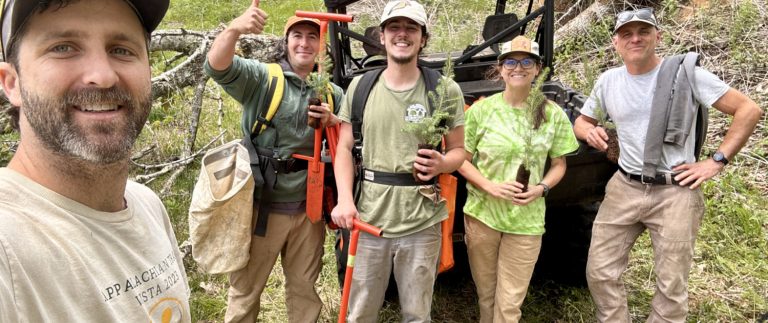
The release of parasitoid wasps on SAHC’s preserve began this year, and the project will stretch over a total of three years: two years of parasitoid wasp release and a third year during which researchers will seek to trap and recover the wasps. Paul explains that in classic biocontrol techniques, the predatory species is released for a specific period of time, then finding them in subsequent years provides evidence that they have been successfully reproducing in the new environment.
“We are losing ash trees at an astonishing rate,” says Dr. Oten. “While it’s great that there are pesticides available to protect the ash resources in our forests, we really need long-term, sustainable management options. Parasitoid wasps may offer that. I’ve been releasing parasitoid wasps in central and eastern North Carolina to combat the emerald ash borer since 2013. Our recent work in the western part of the state, including a site on the Prices Creek reserve, shows that one species of parasitoid wasp in particular is likely suitable for high-elevation areas. Our hope is that these wasp releases result in protection of the ash in those forests.”
Biological Control of the Emerald Ash Borer in Western NC
Contributed by Courtney Smith, Graduate Research Assistant at N.C. State University
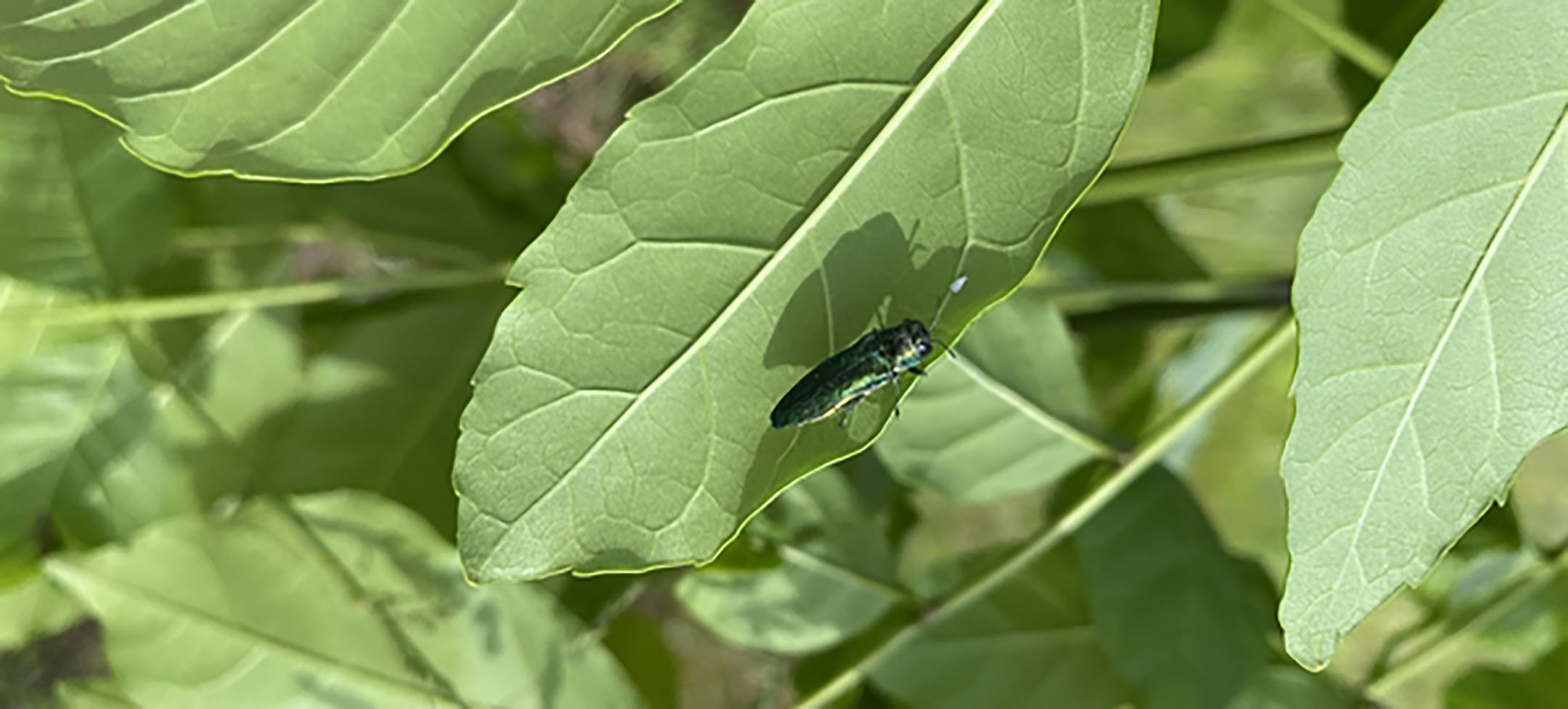
The emerald ash borer (EAB), Agrilus planipennis, is an invasive wood-boring beetle that attacks ash trees (Fraxinus spp). The larvae (immature forms) of the EAB feed beneath the bark of these trees, disrupting nutrient and water flow, eventually killing the host trees. While the beetle is native to Asia, it inadvertently ended up in the US as a product of trade. It was most likely introduced through wood packing material used on ships or airplanes. The beetle was discovered in the United States in 2002 near Detroit, Michigan and has since spread. In 2013, the EAB was found in NC, and it is now present in over 60 counties. Throughout North America, the EAB has killed hundreds of millions of ash trees, which are important components of forests due to their role in providing food and habitat for wildlife as well as ecosystem services like water filtration.

Due to the vast impact of EAB, management is critical for containing and suppressing populations of the beetle. Chemical treatments are available for high-value landscape trees. However, these insecticides can be costly, and they require repeated treatment, so they may not be practical for all natural forest settings. As a result, biological control is often used in forests. Biological control involves using the natural enemies of a pest to suppress it. In the case of EAB, we have used parasitoid wasps to attack the pest. These parasitoid wasps are tiny, non-stinging wasps which deposit their eggs on or inside immature EAB. When the young wasps hatch from these eggs, they feed on the immature EAB, killing the pest. Several parasitoid wasp species that are native to the EAB’s native range have been tested and approved for release in the United States. The United States Department of Agriculture, Animal and Plant Health Inspection Service (USDA-APHIS) rears these wasps and sends them to state cooperators. The wasps can provide adequate control of EAB when the correct species are released in the right location at the right time of year. However, if wasp releases are timed incorrectly or are conducted in an unsuitable location, these biological control agents may not be able to establish or control EAB. As such, research has been conducted on the EAB’s lifecycle as a way to optimize parasitoid releases.
Parasitoid wasps that utilize EAB larvae can provide adequate control of EAB, but they’re a bit picky. Rather than depositing their eggs on recently hatched EAB larvae, these wasps prefer to attack the larger, more mature forms of EAB larvae. As a result, it is important to make sure that the mature forms of EAB larvae are available when adult wasps are laying eggs. To time releases correctly, we must understand EAB phenology; in other words, we have to gain knowledge of what stages of EAB are present at different times of the year. In central NC, it has been found that the EAB has a one-year lifecycle, meaning it develops from egg to adult within one year). As a result, the appropriate parasitoid wasp species should be released in the summer when mature EAB larvae are available. However, a recent model suggested that the life cycle of EAB may be different in western NC. Here, the EAB is predicted to have a semivoltine lifecycle, meaning it can take longer than one year to develop completely. Where the EAB has a one-year lifecycle, it will spend the winter in a “J-stage” in which it bores more deeply into the tree and curls into a shape resembling the letter “J.” However, where the EAB is semivoltine, some EAB will overwinter as larvae just beneath the bark, rather than the “J-shape.” As a result, looking at the EAB’s stage in the winter can help determine whether it has a one-year lifecycle.

To verify the previously mentioned model, research sites were selected in WNC to assess the EAB’s life cycle. One such research site was SAHC’s Prices Creek Preserve. Here, three EAB-infested ash trees were debarked in the winter to collect EAB specimens. While EAB densities were low, EAB larvae were found overwintering just beneath the bark, confirming the model and suggesting that EAB is semivoltine in this area. These results may indicate that parasitoid wasp species which were historically used in more northern states could be suitable for WNC and provide control of EAB. Releases of these wasp species began in the spring at SAHC’s preserve, and they will be assessed for establishment in the future. Hopefully, this research project has added another tool to the EAB management toolbox for the region, helping to protect our valuable ash trees.
For more info, visit content.ces.ncsu.edu/biological-control-of-emerald-ash-borer-in-north-carolina.