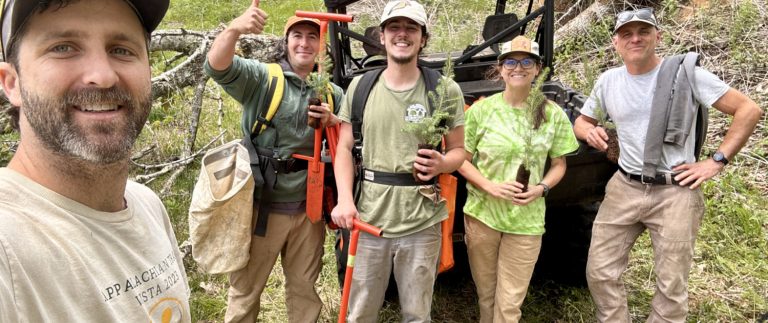
Spring on the farm in the Alexander community has been busy, with a new agroforestry project improving and reshaping the future of land management in our pasture area. Thank you to the dedicated volunteers from Wicked Weed Brewing Company, University of Tennessee in Knoxville, and local residents who have helped in tree planting and other work days on the farm. Want to come see what’s new and exciting? Our Outings team now offers monthly farm tours, and more farm workshops are in the works. Check out the most up-to-date list of upcoming events at Appalachian.org and join us on the farm!
Silvopasture Project
In March, we hosted the first of a 2-part workshop series on planning, planting, and maintaining a silvopasture project. SAHC received a $6,000 Catalyzing Agroforestry Grant to support creating a silvopasture project at the SAHC Community Farm, and the nonprofit organization Contour Lines Corp. donated plant material and design expertise for hands-on workshops. This agroforestry plot is designed as an educational tool to demonstrate regenerative agriculture and soil conservation techniques. It will also serve as a model for larger scale land restoration projects including native species reforestation, diversified fruit and nut production, and silvopasture farming.

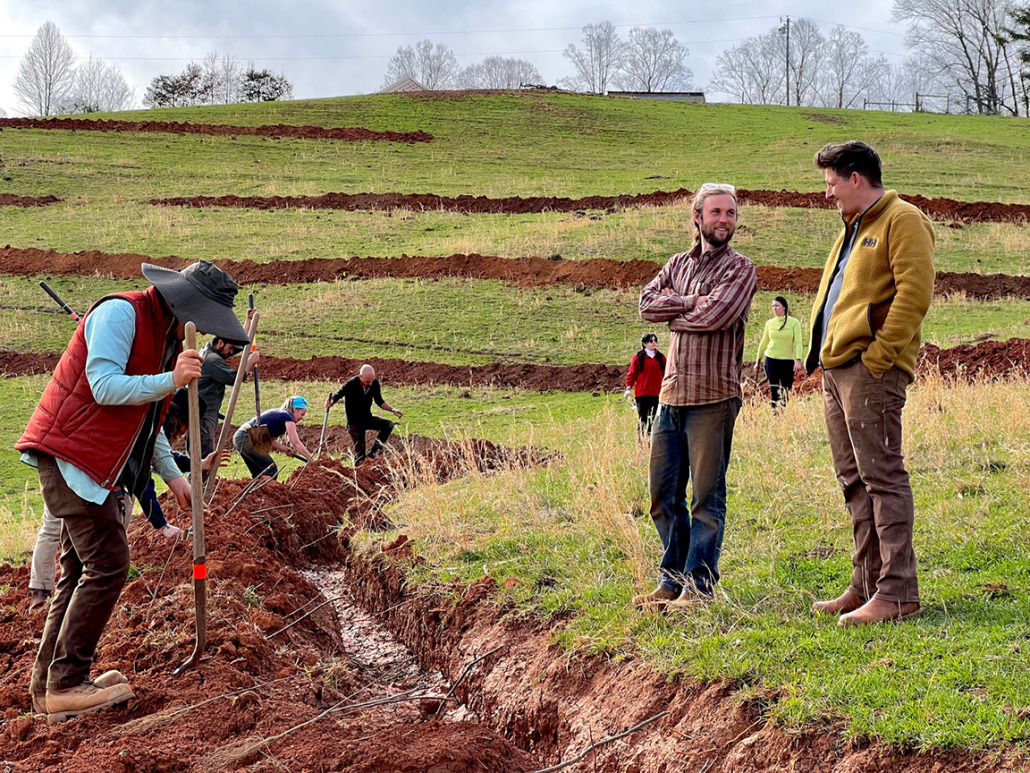
The Catalyzing Agroforestry Grant Program is focused on implementing silvopastures and forest farming practices. SAHC’s project is part of a growing Agroforestry Regional Knowledge (ARK) Exchange that serves as a framework for future growth of agroforestry adoption. Our aim with the silvopasture acreage on the SAHC Community Farm is to make productive and demonstrative use of our hilly pasture. Swales cut into the pasture on contour were planted with a variety of trees and shrubs. Carbon sequestration, value-added products and perennial/no till crops are a few of the beneficial environmental and economic factors in this multi crop plan, and we are confident it will be a great fit for our farm and the needs of our region.
University of TN Volunteers
Ten students from the University of Tennessee in Knoxville volunteered to help at the farm during VOLbreak, an alternative Spring Break of service. They assisted with our new silvopasture project by helping spread straw on exposed swales to protect recently planted fruit and nut trees and cover crops. SAHC’s resident Scottish Highland cattle ventured close to the working students, allowing them to snap a few selfies.
“I’ve never seen a Highland cow in real life,” said one student, excited about the encounter.

Community Farm Manager Chris Link provided an informative talk about the aim of the silvopasture project and the benefits this land management strategy.
“One of the goals of silvopasture is to capture rainwater, deterring erosion and thereby allowing water to absorb into the soil and eventually filter into local streams,” he explained. “ We envision pasturing poultry in the silvopasture project area in the future, where mast produced by mature fruit and nut trees can feed the animals.”
With the straw-spreading done, the students moved to the 26-acre stream restoration area, where they planted 300 bare-root trees, including false indigo, sycamore, and black locust – a nitrogen fixing species of tree native to the southern Appalachians. After lunch, the volunteers planted an additional 300 trees along the contoured swales of the 8-acre silvopasture project area. Future visitors to the farm can expect to see multi-species perennial crops of trees and shrubs taking root along the swales with a wide variety of species, including locust, mulberry, paw-paw, hazelnut, sycamore, indigo, cottonwood, and elderberry. Thank you, volunteers!
Utopian Seed Project
The Utopian Seed Project has expanded their crop trial growing area at the farm.
“Access to farmland is definitely a large challenge for farmers in the United States,” says Utopian Seed Project founder and Executive Director Chris Smith. “As a young agricultural non-profit, we’ve faced the same challenges. In 2022 one of our farm sites was sold and we lost access to that growing space. Having the ability to grow at the SAHC Community Farm really allows us to do our work of crop trials and regional adaptation seed work in an environment that feels safe, secure and supportive.”
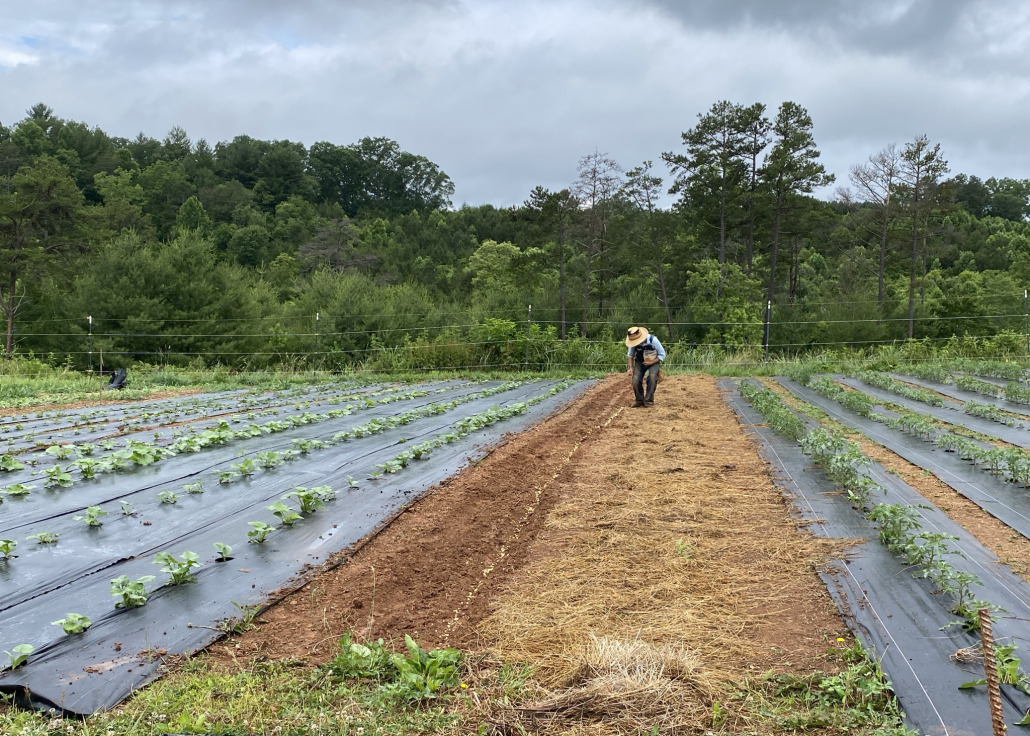
“The Utopian Seed Project runs a lot of crop and variety trials and grows a lot of seed crops,” he continues. “I’m very excited to be growing a large taro variety trial at the Community Farm this year. It’ll be a little patch of Hawaiian-esque paradise! Taro is an excellent crop to grow in the region to support a climate resilient food system – it’s delicious, productive and easy to grow.”

SAHC Community Farm Manager Chris Link is also helping with the design for the Utopian Seed Project’s mobile seed-saving unit.
“In 2022 we launched a WNC Seed Growers Collective as a response to the need to support more regional seed growers,” explains Chris Smith. “The aim is to supply regional farmers with regionally adapted seeds grown by regional farmers, a kind of by-farmers-for-farmers concept. Having regional seed sovereignty and access to varieties suited to our climate is really important, especially as the climate continues to change. One barrier to seed growing is access to seed cleaning equipment; the collective is in the process of outfitting a mobile seed processing trailer that will be a shared resource for our collective. We’re extremely grateful to have the support of SAHC and Chris Link as we work to support farmers in the region.”

SAHC Community Farm work is funded in part by grants from The Community Foundation of Western North Carolina, a grant from the USDA National Institute of Food and Agriculture Beginning Farmer and Rancher Development Program, and a cost-share grant from USDA Natural Resources Conservation Service.